


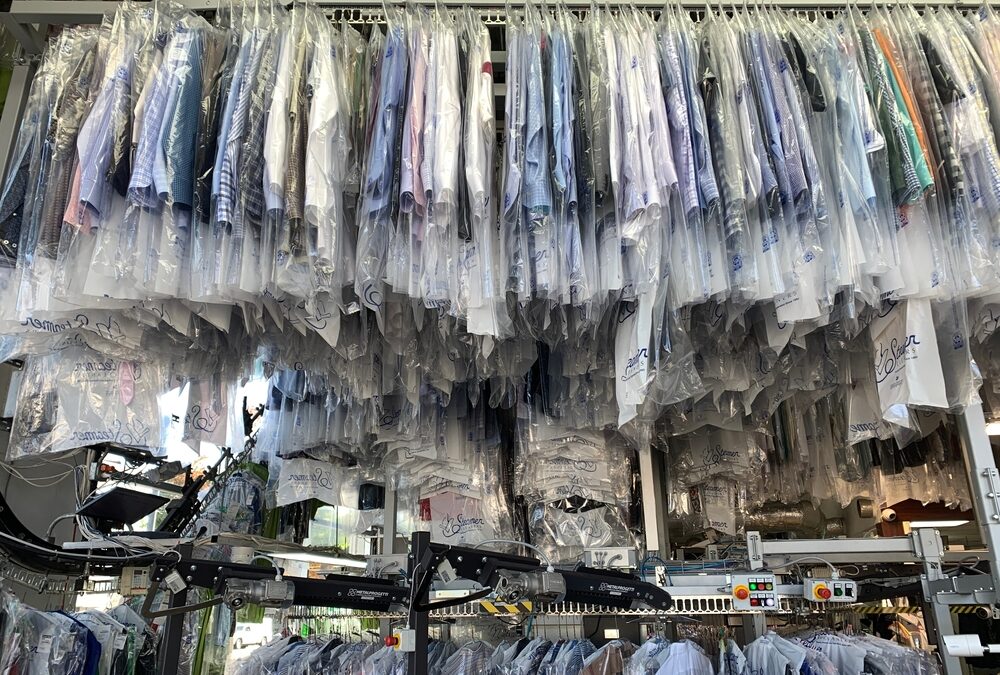
In high-volume commercial and industrial facilities, floor space is a finite and costly resource. For operations managing large quantities of hanging items (such as industrial laundries, dry cleaners, corporate wardrobes, hospitality venues, and fashion logistics hubs) traditional static GoH storage (Garment-on-Hanger) presents an immediate operational bottleneck. It consumes valuable aisle space, limits storage capacity, and forces workers into redundant manual loading and walking cycles.
A professionally engineered garment conveyor system directly addresses these layout and labor challenges. By utilizing the unused space above their heads, facilities can dramatically increase their storage capacity while introducing a touchless workflow that accelerates order processing.
What is a Garment Conveyor System?
A garment conveyor system is a mechanical, track-mounted transport and storage solution designed to continuously handle hanging items. Rather than requiring workers to manually push clothes conveyors along static racks, the conveyor rotation brings the designated item directly to the operator.
At its core, a standard Overhead Garment Conveyor consists of a series of highly reliable mechatronic components:
- Track and Frame: Built with standard 1-1/2″ angle combined with 1-1/4″ outside diameter (o.d.) zinc-plated tubing, utilizing modular design for straightforward installation and future extensions. This modular conveyor system can be floor-supported or suspended directly from the ceiling to create a clear Floor to ceiling conveyor system.
- Conveyor Chain: Consists of a 12″ single or double-tier steel link chain with a chrome finish, featuring 4, 5, or 10 garment slots per link to hold individual garment bags or items securely.
- Drive System: Driven by CSA-approved, totally enclosed fan-cooled motors and drives (typically 1/2 HP to 1 HP) paired with a permanently lubricated reducer. An inverter drive provides essential safety and control features like soft start/stop, variable speed, and overload/jam protection.
- Bearings and Rollers: Load- bearing wheels and trolley bearings consisting of 1-3/8″ o.d. wheels complete with nylon tires on steel cores, navigating corner sections and bends smoothly.
- Operators and Controls: Basic systems rely on simple bi-directional hand or foot controllers. More sophisticated operations utilize an advanced operator interface, such as a touch screen controller or digital remote positioning system, to run automated storage and retrieval cycles.
Industry Applications: Resolving Real Facility Constraints
Garment handling requirements vary by industry. Different operations face unique layouts, throughput rates, and security needs.
E-Commerce and Fashion Logistics
In large-scale distribution centers, maximizing cubic capacity is key to managing business growth. By incorporating multi-tier arrangements, such as a Single-Double Tier Conveyor, operators can hang longer garments on the single tier and shorter items on the double tier. This layout maximizes vertical space utilization without requiring expensive mezzanines.
Industrial Laundries and Dry Cleaners
For industrial laundries and high-volume dry cleaners, fast assembly and reliable sorting are critical. Utilizing a sorting conveyor system or automated garment sorting lines allows operators to manage high volumes of items quickly. An automated put-away and retrieval workflow reduces transit times and ensures high hygiene standards by keeping clean garments off the floor.
Hospitality: Corporate Wardrobes and Coat Check
Large hotels, casinos, and uniform-heavy industries manage thousands of garments for staff daily. A Smart hanging conveyor system tracks corporate wardrobes via integrated RFID / ID Technology, barcode / QR Code, or RFID-UHF garment tracking. An employee simply scans their ID card or user badge, and the uniform movement brings their garments directly to the reception stage. For guest services, a dedicated Coat Check conveyor provides ticketless retrieval, speeding up modern coat checking and eliminating chaotic manual search lanes.
Correctional Facilities: Secure Property Storage
In jails and prisons, security, tracking, and space organization are critical. Specialized Inmate Property Storage Conveyors (such as the Shelf Carousel S-100) are designed to hold heavy-duty property bags in a highly secure, high-density hanging system. Officers retrieve the correct bag via a digital interface, ensuring secure handling and quick tracking.
Operational Advantages of Automated Garment Systems
Investing in an Automated Garment Conveyor system delivers quantifiable improvements across several core performance metrics:
- Significant Space Savings: Replacing static racks with an electric garment conveyor system can increase hanging storage capacity by up to 40% by eliminating wasted aisle space.
- Reduced Labor and Wear: An automated system calculates the shortest path of conveyor rotation to bring items to the worker, reducing manual walking, minimizing physically repetitive labor, and protecting mechatronic components from unnecessary wear.
- Flexible Layout Integration: These systems support custom layouts, allowing the track to include a V-dip design for steep elevation changes, custom rail lengths, and corner curves to navigate tight spaces.
- Scalability: An expandable system built on a modular conveyor system means additional track segments, drive systems, or control technology can be integrated as your storage demands grow.
Understanding the Control Technology
Modern garment logistics require precise, computerized tracking. Rather than relying on physical sorting, advanced facilities use digital controls to manage complex inventories.
- Manual Control: Standard three-position hand or foot switches allow bi-directional jog control, ideal for smaller storage footprints.
- System 100/200 Digital Controllers: These intelligent control units calculate the shortest path to retrieval, stack multiple orders, and prioritize retrieval queues. They can be daisy-chained to network multiple conveyors and integrate directly with warehouse Point-of-Sale (POS) software, enabling ticketless retrieval.
- Barcode and RFID Tracking: When paired with barcode labels, line codes, or RFID-UHF systems, the conveyor can coordinate multi-department zoning and automated put-away. The conveyor interfaces with the host database to route, sort, and store inventory with minimal manual input.
SRS Conveyors: Your Material Handling Partner
Since 1962, SRS Conveyors has specialized in being a turnkey garment material handling solutions provider. We don’t just sell equipment; we deliver customized engineering solutions designed to fit your real facility layouts, load requirements, and throughput goals.
Our proven range of garment and overhead conveyor systems includes:
- Model-ST Standard Conveyor: Engineered to increase hanging capacity by up to 40%.
- Model-DT Double Tier & Model-SD Single-Double Tier Conveyors: Maximizes vertical clearance to optimize storage.
- Model-FC Floor to Ceiling System: Utilizes overhead room height to free up floor level space.
- Model-VD V-Dip & Model-AC Assembly Conveyors: Tailored for efficient, multi-level layouts and fast assembly tasks.
- Model-SC Slide Conveyor: Featuring slot-free handling for fast, flexible order sliding.
- S-200 Sortation Conveyors & EcoFlow™ Sorters: Built for high-velocity distribution demands.
From initial consultation, CAD drawings, and equipment manufacturing to programming, mechatronic component installation, and ongoing system integration, SRS Conveyors handles the technical tasks so you can focus on running your business. Contact us to purchase the best conveyor system for you.
Frequently Asked Questions
What are the power requirements for a standard garment conveyor?
Most standard SRS garment conveyors run on a CSA-approved 115-volt, 60-hertz, single-phase power supply, pulling a fractional horsepower (1/2 HP to 1 HP). Custom inputs are available to match your building’s existing electrical infrastructure.
How do we keep the conveyor chain running smoothly?
To maintain optimal system longevity, an automatic lubricator can be pre-mounted to a standard track section. It is pneumatically operated and electrically controlled via a PLC to deliver precise oiling cycles directly to the chain pins and wheels.
What is the advantage of an enclosed track conveyor vs. a traditional open track?
Enclosed track conveyors house the moving chain entirely within a cold-rolled steel profile. This prevents dust, lint, and moisture from accumulating on the rolling parts, which is especially important in high-lint environments like commercial laundries. It also prevents grease from contacting clean garments or garment bags.
Discuss Your Facility Layout with Our Engineering Team
Ready to reclaim valuable floor space and accelerate your retrieval times? Contact the experienced engineering team at SRS Conveyors. We can review your custom layouts, load requirements, and automation goals to recommend the ideal garment conveyor configuration for your workspace.